The Essence of the Unelaborate — Daily Practice of the Buddha Amitābha
A daily practice of Buddha Amitābha in unelaborate form — refuge, visualization, recitation, and dedication for the practitioner's constant use.
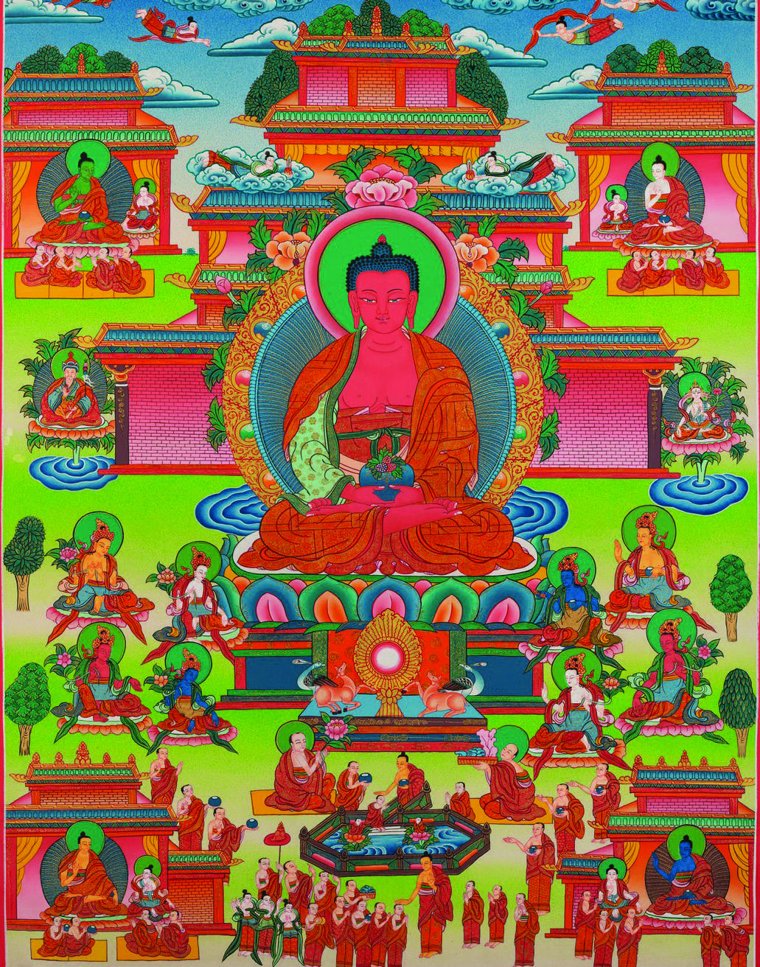
Homage to the Guru inseparable from protector Amitābha
Here, if you wish to do the unelaborate sādhana of Buddha Amitābha, arrange long-life substances, offerings, tormas, and so forth at times if possible. Maintain the visualization continuously so that it pervades everything.
First, refuge and bodhicitta:
To the Gurus, Buddhas, Dharma and Sangha, I and all beings go for refuge.
In order for all mother sentient beings in samsara to attain enlightenment, I give rise to Bodhicitta (repeat three times)
May sentient beings have happiness.
May they be free from all suffering.
May they never be separated from happiness.
May they realize the equality of all phenomena. (repeat three times)
Hrīḥ. From the heart of myself as the deity,
Light rays radiate to the ten directions;
From them I arise as the wrathful-king deity,
Filling heaven and earth, ablaze in the midst of fire.
Om vajra krodha hayagriva raksha raksha hum Demarcate boundary this way.
Generating oneself as the deity:
Āḥ. In the state where samsāra and nirvāna's phenomena are empty,
In the center of the infinite purity of appearance and existence,
Is my own body, the utterly pure celestial palace.
Upon the lotus of my heart, free from attachment,
Upon the stacked sun and moon of method and wisdom,
Is the great wisdom of self-cognizing awareness —
The primordial protector of unchanging light,
In the nature of the Dharmakāya beyond conceptual mind.
Although free from all marks of face and hands,
Yet the unceasing expression of compassion
Arises in the manner of spontaneous presence.
Whatever its ornaments and attire,
Distinct as the unmixed colors of a rainbow, vivid and clear,
The kāya in which samaya-being and wisdom-being are nondual
Abides as the essence of the ocean of victorious ones.
Its three places are marked with Om, Āh, and Hūm.
By the empowerment deities self-arisen naturally from Dharmadhatu,
Conferring empowerment with a stream of amrta,
[The nectar] fills the body, purifies obscurations, and swirls at the crown,
Adorned by Amitābha, the lord of the Buddha family.
The approach [Mantra recitation]:
From the Hrīḥ mantra at my heart,
Light radiates, purifying the obscurations of world and inhabitants.
All appearances, sounds, thoughts, and memories, without exception,
Are imagined as the play of deity, mantra, and wisdom.
OM AMIDEVA HRĪḤ — reciting this as many times as you can, at the end:
Again, by light rays from the heart,
The blessings of enlightened body, speech, and mind
Are gathered back and dissolve into the Hrīḥ,
Which transforms into the essence of great bliss.
HRĪḤ — recite this as much as possible, without distraction.
If one wishes to do the front visualization, focus on the supports.
Purify with Om Svabhāva.
From within emptiness, in the sky in front,
In an expanse where self-appearing rainbow light gathers,
Upon a lotus-and-moon seat,
the syllable Hrīḥ emanated from my heart,
The syllable Hrīḥ transforms completely
Into the form of Bhagavān Amitābha,
Beautiful like a vermilion mountain,
With one face, extremely peaceful and smiling.
Two hands in equipoise holding an alms bowl,
Two legs in the vajra posture,
Bearing the attire of the nirmānakāya,
His three places marked with Om, Āh, Hūm.
Light from his heart invokes the wisdom being;
Invited, samaya- and wisdom-beings merge as one.
Again, by the empowerment Sugata deities
Conferring empowerment with a stream of amrta,
[The nectar] fills the body, purifies defilements, swirls at the crown,
Marked by Amitābha, lord of the Buddha family.
Imagine the offering substances pervading all of space:
By the goddesses arising from the mind,
The five sense-offerings and five sense-pleasures,
The auspicious substances, the seven royal emblems,
And more — are offered as clouds of offering.
Om Vajra Argham, Padyam, Pushpe, Dhupe, Aloke, Gandhe, Naividya, Shabda Praticcha Hum Svaha. (Offerings)
Praise:
Bhagavān, Protector, God of Gods,
By the splendor of the light of wisdom
You dispel the torment of sickness, aging, and death —
Amitābha, to you I pay homage and praise!
The recitation and visualization to invoke the front visualization:
By light rays from my heart,
The mind stream of the deity in front is invoked;
The blessings of enlightened body, speech, and mind,
And the siddhi of longevity — imagine receiving them.
OM AMIDEVA HRĪḤ — reciting this as many times as you can.
If you also wish to accomplish the activity-vase:
From within emptiness, in an instant,
Inside the vase, red Hayagrīva, king of the wrathful ones;
From his body a stream of elixir descends,
And the vase becomes completely filled.
Recite om vajra krodha... one hundred and eight times.
Visualize:
Finally, imagine that the deity melts into light and becomes of one taste with the vase water.
This may also be practiced before the self-generation, in the manner of (sangchu) cleansing water.
If you wish to offer the feast (Ganacakra) on auspicious occasions and so forth:
Over the feast substances, recite three times: Om Āh Hūm
and visualize that they melt into amṛta — purified, realized, and increased (Jang, Tok, Par)
Inviting the guests of the feast:
Gurus, the very root of blessings,
Yidam deities who bestow siddhis,
Ḍākinīs who dispel obstacles,
And the hosts of Dharmapālas who accomplish activity —
To this feast of sense-delights, we invite you.
Having come by the power of your compassion,
And conferred empowerment upon us,
Grant the siddhi of deathless life!
The first portion of the Ganacakra offering:
To the gurus, yidams, ḍākinīs,
And the hosts of Dharma Protectors and guardians,
All delightful offering substances, without exception,
We offer, visualizing them filling all of space.
The middle portion offering:
In the nonduality of the deity and my own mind,
Whatever faults I committed through not knowing —
Confessing them openly in the expanse of self-awareness,
Grant your blessings that I realize their inseparability.
The final portion offering:
The host of Döns that steal my life-force,
The Lord of Death together with his māra legions —
Dissolving them into this feast, I satisfy your mouths;
May [we] be forever free of obstacles!
(If you wish to accumulate the concise feast offering):
OM ĀH HŪM
To the hosts of deathless deities of the three roots
I offer the feast-offering of sense-pleasures.
Dispel the obstacles of untimely death,
And grant the supreme and common siddhis!
Ganacakra pūja khāhi.
Offering the Torma:
In a jeweled vessel, by the three syllables,
Imagine the torma as uncontaminated amṛta.
Mentally invite the guests of the Torma:
Om Amideva Hrīḥ Idaṃ Baling ta kha khāhi khāhi — offer three times.
To us yogins, together with our retinue,
Grant health, long life, and prosperity,
And the [activity] attainments of pacifying, increasing, and so on,
Together with the supreme attainment!
Vajra muh. Imagine that the guests of the torma depart to their own abodes.
Enjoying the feast and dedicating the leftovers:
Bhrūṃ Phaṭ. Imagine the vessel as a kapāla (skull-cup) and its contents melting into the amrta of primordial wisdom.
Mothers and sisters who delight in the leftovers,
Endowed with the magical power to transform things as desired —
Having enjoyed this with delight,
May [our] wishes be spontaneously fulfilled.
Om ucchista balinga baksabhya svāhā — with this, cast out the leftovers.
Make the aspiration prayers as follows:
In the mandala of Heruka,
By offering the wheel of the feast (Ganacakra),
May I and all others — beings without exception —
Reach accomplishment together in a single mandala.
Unstained by the defilements of faults and downfalls,
And perfecting the vast and mighty conduct,
May I attain, in this very life,
The state equal to Heruka.
May all sentient beings, my fathers and mothers, come to have happiness.
May all the lower realms be forever emptied.
Whatever Bodhisattvas dwell upon the grounds (Bhumis),
May the aspirations of them all be fulfilled.
The concluding ritual:
Make offerings as before, from Om vajra argham up to shabda.
Bhagavān, Protector, God of Gods,
By the splendor of the light of wisdom
You dispel the torment of sickness, aging, and death —
Amitābha, to you I pay homage and praise!
Having praised thus, if you wish to receive the siddhis:
O deity of long life, who conquers the Māra Lord of Death,
Upon my three — body, speech, and mind —
Bestow the blessings of your enlightened body, speech, and mind,
And grant, I pray, the siddhi of long life!
With this, partake of the long-life substances.
Recite the hundred-syllable mantra to repair excesses and omissions.
Ask for forgiveness with the verses;
Whatever I failed to provide, whatever was impaired,
And whatever, through my deluded mind,
I have done [wrongly] or caused [others] to do —
I beseech you to forbear it all.
The wisdom deity generated in front
Departs into the natural Dharmadhātu.
The aspect of myself appearing as the deity's form
Dissolves into the essence of innate mindful awareness.
Thus dissolve into emptiness and arise again in the form of Amitabha Buddha:
By this virtue, may I swiftly
Accomplish [the state of] the protector Amitābha, — and so forth;
Dedicate the merits towards the enlightenment of all beings;
"May all beings who hear my name
Be born in my pure realm" — so you aspired;
Therefore, by the power of my devoted supplication,
May they be born in the realm of Sukhāvatī!
Perform the stages of aspiration prayers, verses of auspiciousness, and so forth appropriately. Furthermore: recognizing awareness (rigpa) as the deity's form, so that all appearance and existence arises as the deity's mandala, is the intent of Atiyoga.
Knowing one's own body as the very nature of the deity's mandala is the intent of Anuyoga. And clearly visualizing the outer face, hands, and attributes, then being introduced [to their nature] through recollecting their essential purity, and so engaging the meaning — this generation is the system of development-stage Mahāyoga. Accordingly, here too the self-generation has been arranged in keeping with the intent of Anuyoga and Atiyoga, and the front-generation in accordance with the system of Mahāyoga.
This, too, was composed by the one bearing the Bodhisattva name Yeshey Oephoe ("Radiating with wisdom" — the Bodhisattva name of His Holiness the 70th Je Khenpo) for his own recitation practice. May it become virtuous and excellent!
Translated by Lopen Sonam Bumdhen, Research and Translation office of His Holiness the Je Khenpo, 27 October 2024