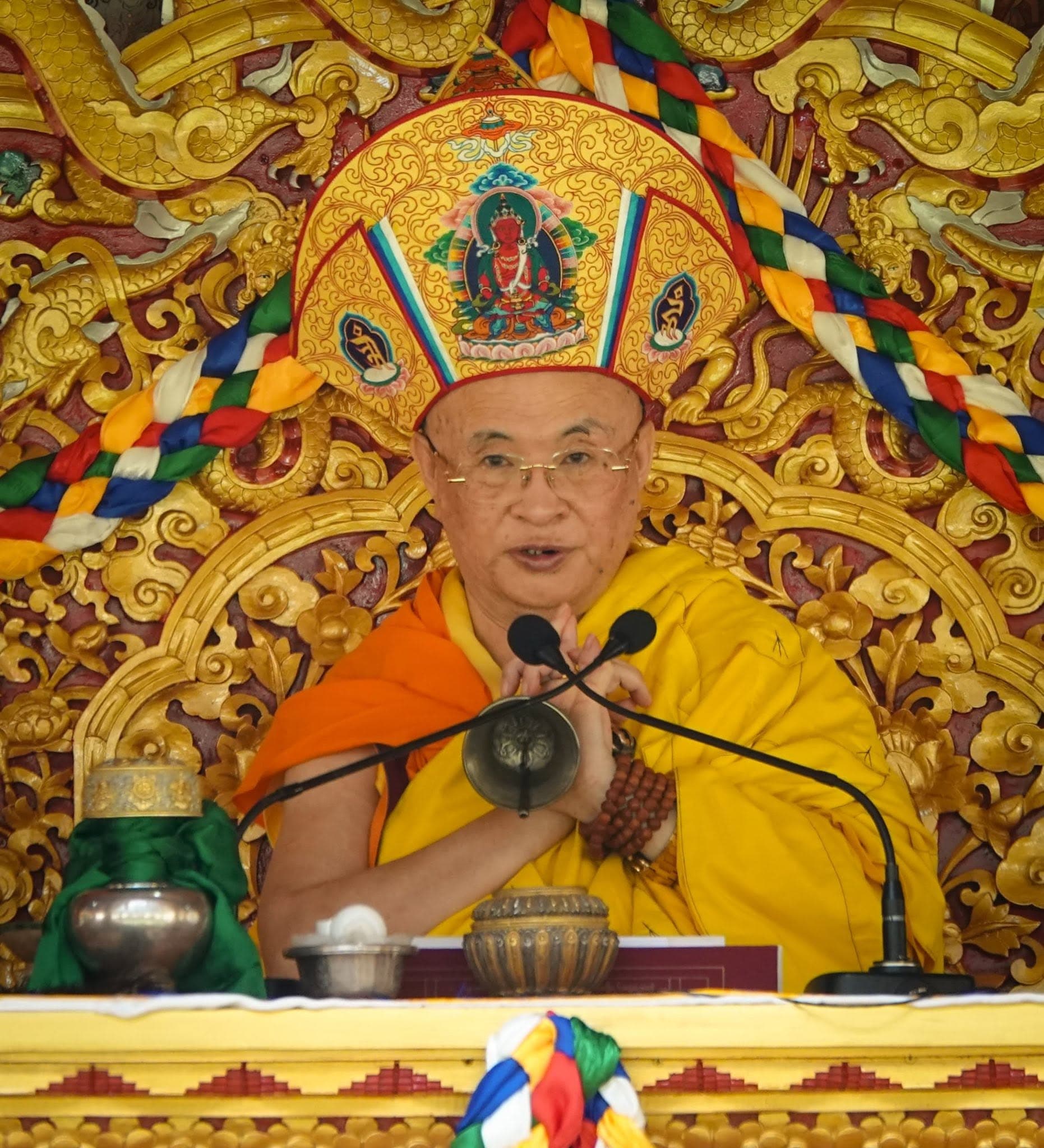
Trulku Jigme Choedrak
Trulku Jigme Choedrak
His Holiness Trulku Jigme Choedrak is the 70th Je Khenpo, the Chief Abbot of Bhutan and spiritual head of the Zhung Dratshang, the Central Monastic Body. The office was established in the seventeenth century by Zhabdrung Ngawang Namgyal, the founder of the Bhutanese state, and its holder is entrusted with the monastic community of the country and the continuity of its teaching lineages. Enthroned in 1996, His Holiness is the longest-serving Je Khenpo of the modern era.
Birth and recognition
His Holiness was born on the fifth day of the seventh month of the Wood Sheep year, 1955, at Drubtse Goenpa, at the foot of Phuningla in Tsenkhar gewog, Lhuentse, in eastern Bhutan. His father was Yab Rinzin Dorji and his mother Yum Kuenzang Choden.
It is recorded that by the age of three he could vividly recall his former lives. The great yogi Lama Sonam Jampo recognised him as the reincarnation of Geshe Pema Tshering, the learned sage of Tharpaling in Bumthang, who had been a teacher to the Second King, Jigme Wangchuck.
Early training
At the age of eight he entered Druk Sang-ngag Choeling, the Drukpa Kagyu monastery in Darjeeling, India, where he received novice ordination from Drukpa Thugsey Rinpoche. There he trained in ritual and in the reading of the scriptures under Khenpo Sonam Dargye and Khenpo Noryang.
At the age of ten he received the reading transmission of the Kangyur, the collected words of the Buddha, together with empowerments and treasure teachings, from His Holiness Dudjom Rinpoche in Kalimpong.
Study and retreat
At about the age of fifteen he returned to Bhutan and joined Tango Drubdey, the meditation seat above the Thimphu valley. There he studied under the 68th Je Khenpo, Ngawang Tenzin Dhondup, receiving the complete initiations and instructions of the Drukpa Kagyu tradition and of Dzogchen.
Between the ages of twenty-one and thirty he deepened his training under both the 68th Je Khenpo and the 69th Je Khenpo, Geshe Gendun Rinchen, studying Buddhist philosophy, Mahāmudrā and classical literature, and mastering the thirteen major treatises of the monastic curriculum.
His Holiness completed the traditional retreat of three years, three months and three days (lo sum chog sum) three times. Over a span of some ten years in retreat he took as his practice the principal Vajrayāna cycles, among them Lama Drubpa, Demchog (Cakrasaṃvara), Tandin (Hayagrīva), Dorji Phagmo (Vajravārāhī), Sengdongma, Mitrugpa (Akṣobhya), Chenrezig (Avalokiteśvara) and Dzogchen.
Service to the Central Monastic Body
In 1984 he was appointed to lead the Shedra, the monastic college, at Tango. In 1986 he was appointed Drapai Lopon, the master of liturgy and chant, of the Central Monastic Body, and served in that office until he stepped down in 1990. In the years that followed he taught at Chungney Goemba in Wangdue Phodrang.
In 1995, at the age of forty, he was appointed Dorji Lopon, the master of Vajrayāna practice and one of the four great lopons of the Central Monastic Body, by His Majesty the Fourth Druk Gyalpo, Jigme Singye Wangchuck. As Dorji Lopon he gave teachings on the Kangyur and taught the thirteen texts of Tertön Sangye Lingpa. He also travelled through several districts giving teachings on the preliminary practices (ngöndro), the Nyingthig, and Kunzang Lamai Zhelung, The Words of My Perfect Teacher.
Enthronement as the 70th Je Khenpo
On the tenth day of the third month of the Bhutanese calendar in 1996, His Holiness was enthroned as the 70th Je Khenpo of Bhutan, among the youngest to have held the office. In the same year he was conferred the Royal Saffron Scarf.
Since then he has led the Zhung Dratshang, presiding over its seasonal migration between Thimphu and Punakha, its great annual rites and the ordination of monks, and extending monastic education across the country.
Reforms for the benefit of the people
Among His Holiness's best-remembered acts are his reforms of funeral practice. He discontinued the offering of chhangep, phuechha, soeja and soetsho, gifts in cash or in kind once expected of bereaved families at cremations, which came as a great relief to rural households. He also banned meat and alcohol at cremation grounds, so that every family can cremate its dead with dignity and without ruinous expense.
Out of compassion for animals, he restricted the import of meat during the auspicious months of the Buddhist calendar, and he established Tshethar Tshogpas, associations for the release of animals' lives, across the country. At the Thimphu crematorium he established the Mitrub Lhakhang. He has also donated medical equipment to the nation's health services.
Teacher, author and poet
His Holiness has composed prayers, practice texts, poems and songs, and has set some of them to music. Several of his compositions are gathered on this site, among them his counsel distinguishing what is Dharma from what is not, his offering of gratitude to all parents, his reflection on the offering of tea, and practices of the Buddha Amitābha and of Avalokiteśvara.
Honours
On 17 December 2018, on the National Day of Bhutan, His Majesty the King conferred upon His Holiness the Order of the Druk Gyalpo, the nation's highest civilian decoration, in recognition of a lifetime of service to the nation. In 2025 the country celebrated His Holiness's seventieth birthday.